
While the world was distracted by OpenAI’s pricing controversy, Amazon just quietly dropped a nuclear bomb on the software industry.
At the latest AWS conference in Las Vegas, Amazon unveiled a new class of AI models called AWS Frontier Agents. These aren’t just chatbots or coding assistants. They are autonomous, long-running employees that can work for days without human supervision.
The three agents—Kiro (Developer), Security Agent, and DevOps Agent—signal the final transition from “Co-Pilot” to “Auto-Pilot.” If you thought Devin was impressive, wait until you see what happens when you give an agent root access to the AWS cloud.
Here is my comprehensive analysis of AWS Frontier Agents, the new “Kiro” developer, and what this means for your career in 2026.
1. What Are AWS Frontier Agents?
AWS Frontier Agents represent a fundamental shift in AI architecture. Unlike ChatGPT or Claude, which are “stateless” (they forget you after the chat closes), Frontier Agents are designed for Persistent Autonomy.
They are built on the new Amazon Bedrock AgentCore, a platform that gives AI agents memory, tool access, and the ability to “loop” on a problem for hours. You don’t chat with them; you assign them a ticket in Jira, and they close it.
The Three Killers:
- Amazon Kiro: The Autonomous Developer (Direct rival to Devin/Cursor).
- AWS Security Agent: The Autonomous Pentester.
- AWS DevOps Agent: The Autonomous Site Reliability Engineer (SRE).
This trio covers the entire software lifecycle: Build, Secure, and Run. Humans are no longer the operators; we are the supervisors. You can read more about the official launch on the AWS News Blog.
2. Amazon Kiro: The “Devin” Killer?
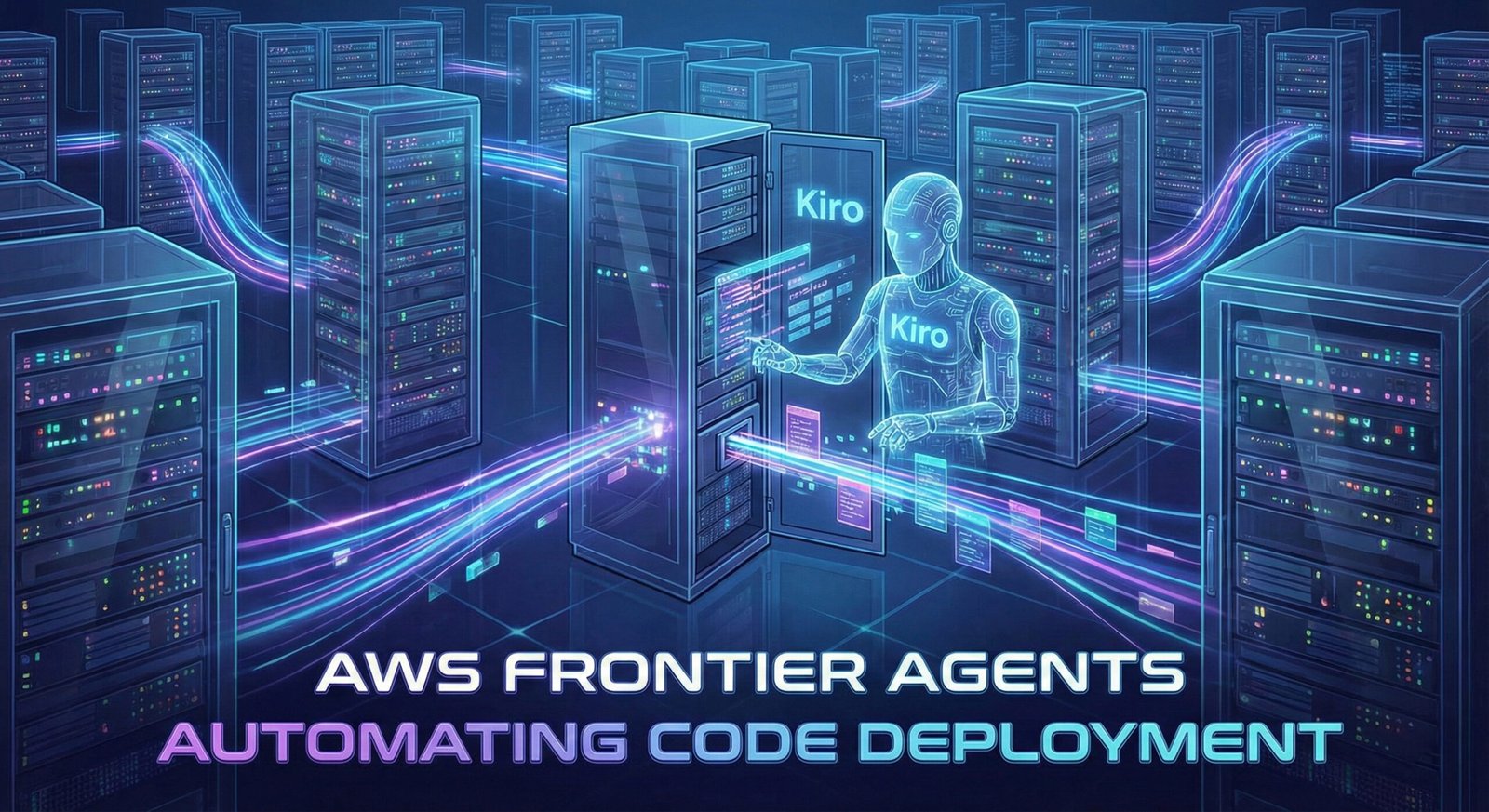
The star of the show is Amazon Kiro. While tools like Cursor and Windsurf act as “Editors,” Kiro acts as a “Teammate.”
How Kiro Works:
- Deep Context: Kiro doesn’t just read your open file. It indexes your entire AWS environment, your Git repo, and your documentation.
- Asynchronous Execution: You can ask Kiro to “Refactor the billing microservice to use Stripe API v3.” Kiro will create a branch, write the code, run the tests, fix the bugs, and submit a Pull Request.
- Tool Use: It natively understands AWS SDKs. It won’t hallucinate a fake S3 bucket; it will query your actual S3 configuration to verify it exists.
For enterprise companies already on AWS, Kiro eliminates the friction of “Context Switching.” You don’t need to copy-paste logs into ChatGPT. Kiro already sees the logs.
3. The AWS Security Agent: Automated Pentesting
As we discussed in my article on Autonomous Agents Security, the biggest risk to AI is security. Amazon’s answer is to fight fire with fire.
The AWS Security Agent doesn’t just scan for bugs; it actively attacks your code.
Capabilities:
- Threat Modeling: It reads your architecture diagrams and identifies theoretical weaknesses.
- Code Review: It scans every PR for vulnerabilities (SQL injection, IAM permission leaks) before a human sees it.
- Continuous Pentesting: It constantly probes your live infrastructure for misconfigurations.
This effectively replaces the role of a “Junior Security Analyst.” Instead of hiring someone to stare at logs, you hire an agent to fix them.
4. The DevOps Agent: The End of “On-Call”
The most painful part of software engineering is being on-call. Waking up at 3:00 AM to restart a server is miserable. The AWS DevOps Agent aims to end this.
It connects to Amazon CloudWatch and X-Ray. When an alarm goes off, the agent:
1. Detects the spike in latency.
2. Correlates it with the last deployment.
3. Identifies the root cause (e.g., “Memory leak in container 4”).
4. Mitigates the issue (e.g., “Rolling back to previous version”).
5. Reports the incident to Slack.
By the time the human engineer wakes up, the fire is already out.
5. The Infrastructure: Bedrock AgentCore
What makes AWS Frontier Agents different from a custom script running GPT-4? It’s the infrastructure. Amazon has launched Bedrock AgentCore, a managed service for building these agents.
AgentCore solves the hardest problems in agentic AI:
- State Management: Remembering where the agent is in a 50-step process.
- Permissions: Ensuring the agent doesn’t accidentally delete your production database (IAM integration).
- Orchestration: Handling the hand-off between Kiro (Developer) and the Security Agent.
This is the “OS for Agents” that OpenAI Operator is trying to build, but AWS has the advantage of owning the cloud they run on.
6. The Economic Impact: Why Companies Will Switch
Let’s go back to the economic math from my Death of Entry-Level Coding analysis. Why would a CTO pay $150,000 for a junior DevOps engineer when they can spin up an AWS DevOps Agent for $500/month?
AWS Frontier Agents are not priced per seat; they are priced per task. This aligns incentives perfectly. You only pay when work gets done. For startups, this lowers the barrier to entry. You can launch a scalable, secure, compliant app with a team of one human and three agents.
7. How to Prepare: The “Supervisor” Skillset
If you are a developer reading this, do not panic. Pivot.
The release of AWS Frontier Agents means your value is no longer in writing Terraform scripts or configuring VPCs. Your value is in Defining the Architecture.
- Learn Agentic Patterns: How do you manage a team of AI agents?
- Master Observability: You need to know how to monitor Kiro to ensure it isn’t hallucinating bugs.
- Focus on Business Logic: Let the agents handle the plumbing. You focus on the product.
Verdict: The Cloud Just Got Smart
AWS Frontier Agents are the missing link between “Generative AI” and “Productive AI.” For years, AWS was just a collection of dumb pipes (storage, compute, database). Now, the pipes have a brain.
This release solidifies Amazon’s position not just as a cloud provider, but as the default platform for the Agentic Economy of 2026. If you aren’t building with these tools, you are building the hard way.
Frequently Asked Questions (FAQ)
What are AWS Frontier Agents?
AWS Frontier Agents are a set of autonomous AI tools (Kiro, Security, DevOps) designed to perform complex, long-running tasks in the AWS cloud without constant human supervision.
Is Amazon Kiro free?
Amazon Kiro is currently in preview. Pricing has not been fully released, but it will likely follow a usage-based model (tokens/compute) rather than a flat subscription like GitHub Copilot.
How does the AWS Security Agent work?
It integrates with AWS Security Hub and your code repositories to actively scan for vulnerabilities, perform threat modeling on architecture diagrams, and auto-remediate issues in code.
When will AWS Frontier Agents be available?
The agents were announced at AWS re:Invent and are currently rolling out in “Preview” mode for select AWS customers, with general availability expected in early 2026.