If you are a Computer Science student or a bootcamp grad in late 2025, you have likely felt the shift. The job postings for entry-level coding roles are disappearing. The interviews are getting harder. And the tools we use to write code are starting to write it better than we can.
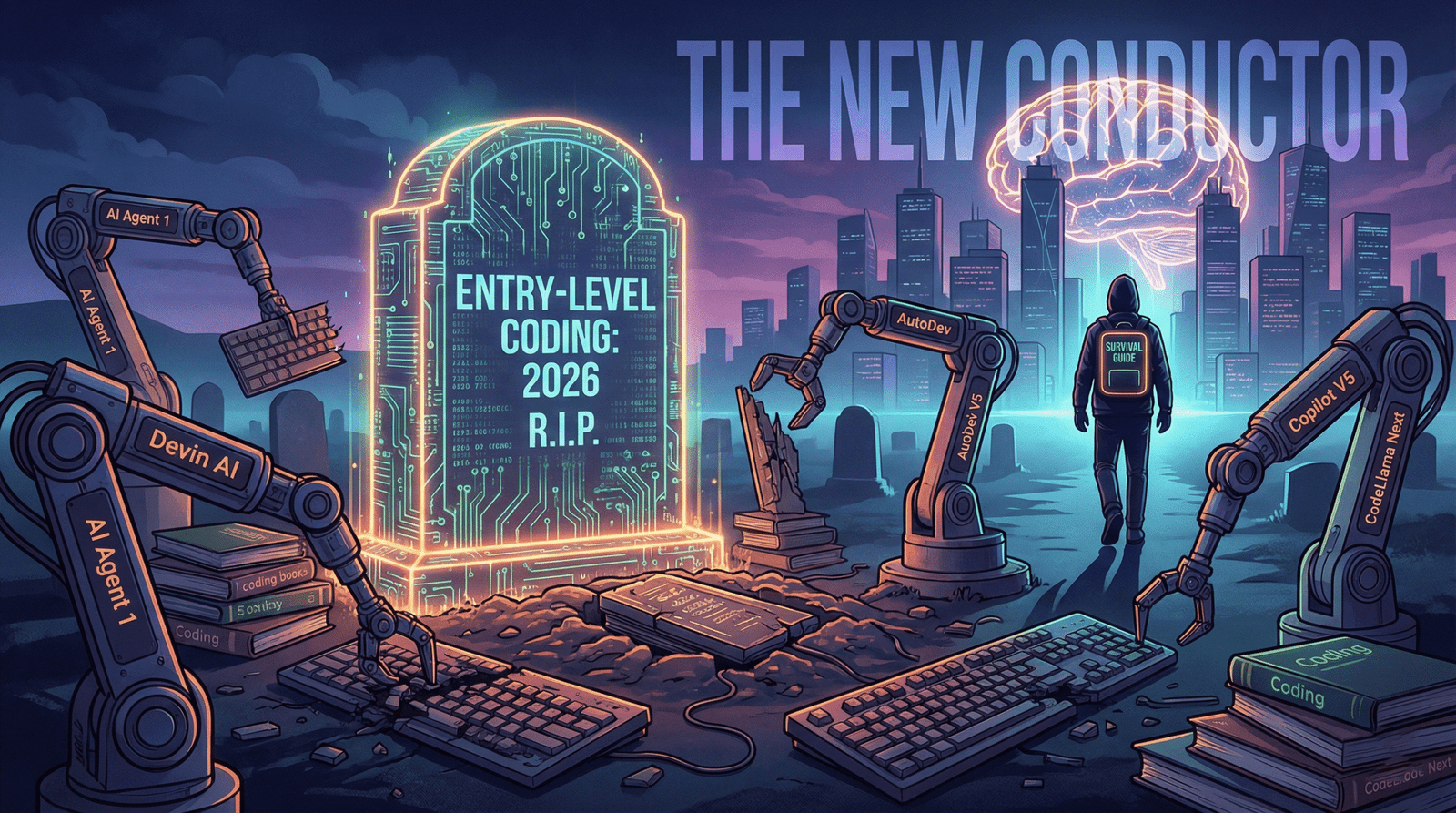
With the maturity of autonomous agents like Devin (now in Enterprise v3) and Microsoft’s AutoDev framework, the industry is silently witnessing the death of entry-level coding as we know it.
But this isn’t a funeral; it’s a forced evolution. Here is the cold reality of what it means to be a junior developer in 2026, and exactly how you can survive the automation wave.
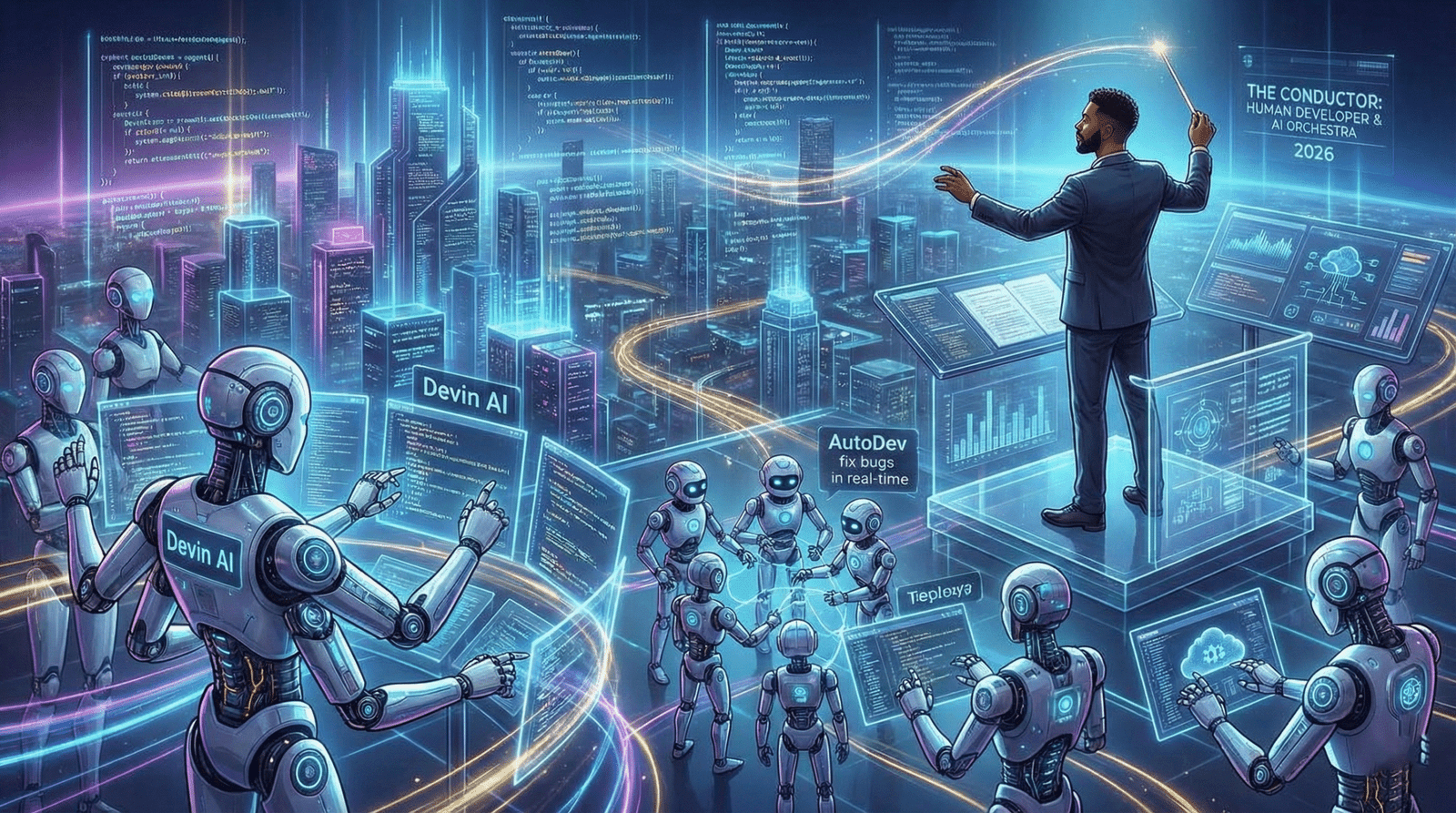
1. The “Junior” Task is Dead: The Economic Reality
Let’s look at the data. According to recent 2025 industry reports, hiring for entry-level coding roles has dropped by nearly 25% since the AI boom began. Why? It comes down to cold, hard economics.
The traditional “Junior Developer” was essentially a paid apprentice. Companies lost money on them for the first year, hoping they would become profitable Seniors later. Today, AI has broken that model.
The Old Math (2022):
- Junior Salary: $80,000/year
- Onboarding Time: 3-6 months (Productivity drain on Seniors)
- Output: Fixes bugs, writes unit tests, builds simple UIs.
The New Math (2026):
- Devin Subscription: $500/month ($6,000/year)
- Onboarding Time: 0 minutes.
- Output: Fixes bugs instantly, writes 100% test coverage, works 24/7.
If your value proposition in entry-level coding is “I can write clean Python functions,” you are competing with a model that costs $0.10/hour and never sleeps. You will lose that battle every time.
2. Meet the Killers: Devin & AutoDev
To understand the threat to entry-level coding, you have to understand the tools that are replacing the “Ticket Taker” workflow.
Devin (Cognition AI)
Devin isn’t just a chatbot; it’s a remote employee. With the new “Devin Expert” persona released this month, it can now handle enterprise-grade migrations. Case in point: Nubank used Devin to refactor millions of lines of legacy code, achieving 12x efficiency compared to human engineers.
Devin can read documentation, learn new technologies on the fly, and deploy code to production. A graduate focusing on entry-level coding who needs 2 days to learn a new library simply cannot compete with Devin’s instant adaptability.
Microsoft AutoDev
While Devin gets the hype, AutoDev is the silent giant. It is Microsoft’s framework for “fully automated AI-driven development.” It uses Docker containers to let AI agents execute complex build processes safely.
AutoDev turns the IDE into a command center where the human is the Supervisor, and the AI is the Worker. It assigns tasks to different agents (one for testing, one for coding, one for reviewing) and manages the workflow automatically. This creates a massive barrier for those trying to break into entry-level coding without architectural skills.
3. The Rise of the “Product Engineer”
So, is the career over? No. But the title “Junior Developer” is dying. It is being replaced by the “Product Engineer.”
In the past, entry-level coding meant you were given a small, defined task (e.g., “Change the button color”). In 2026, AI does that instantly. The new entry-level role requires you to own a Feature from start to finish.
Companies are no longer hiring people to write code; they are hiring people to ship products. They want developers who can say:
“I used AI to write the frontend, backend, and database schema, and I deployed it myself in 2 days.”
This is a massive jump in expectations. The “Safe Zone” of just writing functions is gone. You must become a “Full-Stack Orchestrator.”
4. The “Soft Skills” Moat: What AI Can’t Do
There is one area where humans still dominate entry-level coding candidates: Communication.
AI cannot sit in a meeting with a confused Product Manager and figure out what they *actually* want vs. what they *say* they want. AI cannot negotiate feature scope. AI cannot understand office politics or user empathy.
The “10x Engineer” of 2026 isn’t the one who types the fastest. It’s the one who can translate messy human business requirements into clean technical specs that an AI agent can execute.
5. The 2026 Salary Shift
We are seeing a bifurcation in salaries that affects everyone in entry-level coding.
- The “Code Monkey” (Decreasing): If you only write code that AI generates, your salary is trending down towards $50k-$60k. You are viewed as a “Human in the Loop” verifier.
- The “AI Architect” (Increasing): If you know how to chain DeepSeek R1 with Windsurf to build complex systems, entry-level salaries are actually rising to $120k+. Companies will pay a premium for people who can wield these new weapons.
How to Survive: The 2026 Syllabus
If I were learning entry-level coding today, I would throw away the traditional bootcamp curriculum. Here is what I would learn instead:
- Stop memorizing syntax. You don’t need to know every array method in JavaScript by heart. Cline knows them. Focus on logic.
- Start learning “Systems.” Learn Docker, Kubernetes, CI/CD pipelines, and Cloud Architecture (AWS/GCP). These are the “plumbing” layers that AI still struggles to touch because a mistake here brings down the whole company.
- Build “Agentic” Apps. Don’t just build a To-Do list. Build an app that uses LLMs to do work. Show employers you understand the new stack (LangChain, vector databases, RAG).
Verdict: Adapt or Perish
The era of the “Code Monkey” is officially over. The bar for entry-level coding has been raised into the stratosphere. To get hired in 2026, you need to be as productive as a Senior Developer was in 2022.
The good news? You have the tools to do it. Devin and AutoDev aren’t just your competitors; they are your exoskeleton. If you learn to wield them, you become a super-developer. If you ignore them, you become obsolete.
Frequently Asked Questions (FAQ)
Will AI replace entry-level coding jobs completely?
Not completely, but it will drastically reduce the number of seats available. The surviving entry-level coding roles will require higher-level thinking, system design skills, and the ability to manage AI tools effectively.
Is it still worth learning entry-level coding in 2026?
Yes, but the focus has changed. Instead of syntax, focus on computer science fundamentals, logic, and architecture. Understanding how code works is more important than writing it yourself.
What is Microsoft AutoDev?
AutoDev is a framework that allows AI agents to autonomously plan and execute complex software engineering tasks within a secure environment, effectively acting as an automated developer managed by a human supervisor.
How much does Devin AI cost?
Devin’s pricing is enterprise-focused, but efficiency reports suggest it can offer 20x cost savings on large refactoring tasks compared to human teams, making it a highly attractive option for CTOs looking to cut entry-level coding costs.