
Disney generative AI strategy represents a major shift in how large, intellectual-property-driven companies scale content while maintaining strict control over brand safety, creative integrity, and legal rights.
As demand for content continues to grow across platforms and audiences, Disney must balance speed with governance. Generative AI offers efficiency and flexibility, but unmanaged use can introduce serious legal, creative, and operational risks. Disney’s partnership with OpenAI demonstrates how enterprise AI can be embedded directly into core systems rather than treated as a side experiment.
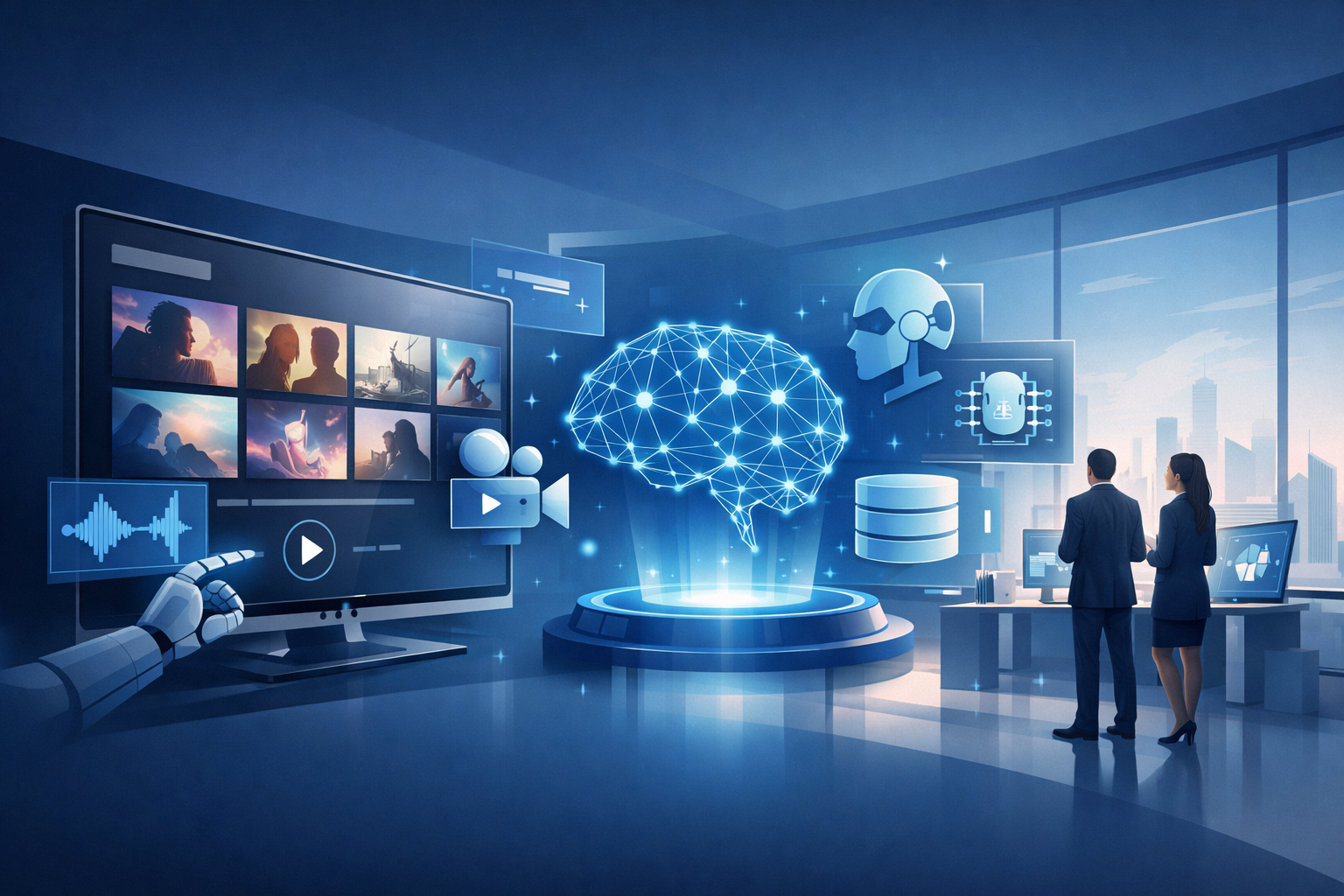
Disney Generative AI Strategy as Infrastructure, Not an Experiment
Under this agreement, Disney operates as both a licensing partner and a major enterprise customer. OpenAI’s video model, Sora, enables short, prompt-driven video generation using a tightly controlled set of Disney-owned characters and environments.
At the same time, Disney leverages OpenAI APIs to develop internal tools and consumer-facing experiences, including features integrated into Disney+. Internally, employees gain access to ChatGPT as a standardized productivity assistant instead of relying on fragmented tools.
Crucially, Disney is not opening its entire catalog to unrestricted AI generation. Actor likenesses and voices are excluded, asset usage is predefined, and strict safety and age-appropriate controls are enforced. This transforms generative AI into a governed production layer rather than a creative free-for-all.
Embedding AI Directly Into Existing Workflows
Many enterprise AI initiatives fail because they exist outside real workflows. Tools are added on top of existing systems, increasing friction instead of reducing it. Disney’s approach places AI exactly where decisions and production already occur.
On the consumer side, AI-generated outputs appear directly within Disney+, not through standalone experiments. On the enterprise side, AI is accessed via APIs and standardized assistants, making usage observable, measurable, and easier to govern.
This approach reflects a broader shift toward intelligent automation, similar to how
AI agents are transforming enterprise automation
.
Scaling Content Variation Without Increasing Headcount
The Sora license focuses intentionally on short-form content derived from pre-approved assets. In large-scale production environments, the highest costs are rarely ideation but generating usable variations, reviewing outputs, and distributing content efficiently.
Prompt-driven generation within a controlled asset set lowers the marginal cost of experimentation and fan engagement without increasing manual production or review workloads. These outputs serve as controlled inputs for marketing, social media, and engagement pipelines rather than finished films.
This reflects a broader enterprise pattern where AI proves its value by shortening the distance between intent and usable output.
Why Disney Prioritizes APIs Over Standalone AI Tools
Beyond content generation, the Disney generative AI strategy positions OpenAI models as modular building blocks. Instead of relying solely on off-the-shelf interfaces, Disney uses APIs to develop custom internal tools and consumer products.
Enterprise AI programs often stall at the integration stage. API-level access allows AI to be embedded directly into product logic, employee workflows, and existing systems of record. This makes AI part of the connective tissue of the organization.
For deeper insights into enterprise AI development, visit
OpenAI Research.
Aligning AI Productivity With Business Economics
Disney’s $1 billion equity investment in OpenAI is less important as a valuation signal and more significant as an operational commitment. It signals that AI is expected to be persistent, central, and embedded into long-term strategy.
AI initiatives fail when they remain disconnected from economic outcomes. In this case, AI directly influences Disney+ engagement, content production costs, and internal productivity. This alignment ensures AI becomes part of standard planning cycles rather than experimental innovation spending.
Automation That Makes Scale More Resilient
At high volumes, AI amplifies small failures. Disney emphasizes safeguards around intellectual property protection, harmful content prevention, and misuse not as a philosophical stance, but as a scaling necessity.
Automated safety and rights management reduce the need for manual intervention and support consistent enforcement. This operational AI may go unnoticed when it works—but it makes growth far less fragile.
Disney’s broader innovation direction aligns with trends highlighted by
The Walt Disney Company
.
Key Lessons for Enterprise Leaders
- Embed AI where work already happens: Focus on real workflows, not isolated experiments.
- Constrain before scaling: Defined assets and exclusions reduce risk.
- Use APIs to reduce friction: Integration matters more than interfaces.
- Align AI with business economics: Productivity gains must connect to revenue and cost structures.
- Treat safety as infrastructure: Governance and automation are prerequisites for scale.
This approach mirrors trends discussed in our article on
AI tools for content creation
.
Frequently Asked Questions (FAQ)
What is Disney generative AI strategy?
Disney generative AI strategy focuses on embedding AI into core workflows using controlled assets, strong governance, and API-driven integration to safely scale content and productivity.
Does Disney allow unrestricted AI use of its characters?
No. Disney enforces strict limits, excluding actor likenesses and voices while applying asset restrictions and safety controls.
Why does Disney rely on APIs instead of standalone AI tools?
APIs allow AI to integrate directly into existing systems, reducing friction and making AI usage easier to scale and govern.
How does this strategy benefit Disney+?
AI enhances engagement through controlled content variation and personalized experiences without increasing operational risk.
What can enterprises learn from Disney’s AI approach?
Enterprises can learn that AI delivers sustainable value when it is governed, integrated into workflows, and aligned with business incentives from the beginning.