
SmartHackly
  • Home
  • News
  • AGI
  • Open Source
  • AI Applications
  • Startups
  • Enterprise
  • Resources
  • Robotics
No Result
View All Result
SAVED POSTS
SmartHackly
  • Home
  • News
  • AGI
  • Open Source
  • AI Applications
  • Startups
  • Enterprise
  • Resources
  • Robotics
No Result
View All Result
SmartHackly
No Result
View All Result
Who is Winning? A look at OpenAI's 'Stargate' vs. Google's TPU Pods

OpenAI vs. Google: A Look at the ‘Stargate’ and TPU Pod Battle

November 12, 2025
in AGI
0
Share to Facebook

Imagine a single company spending over $4 billion on computer chips in one year. That’s the staggering reality for OpenAI in 2024. This astronomical figure highlights the immense pressure driving a seismic shift in the AI world.

For the first time, OpenAI is now renting Google’s custom chips to power its products like ChatGPT. This move breaks its exclusive reliance on Nvidia hardware and Microsoft data centers. It signals a major change in strategy for one of the leading AI companies.

This decision places Google as a solid number two in the AI chip market. Their decade-long investment in custom silicon is finally attracting landmark clients. The deal is so significant it’s straining Google Cloud’s own capacity.

I’m examining this critical infrastructure shift. It represents a fundamental disturbance in the Nvidia-dominated landscape that has defined AI computing for years. The economic pressures are undeniable, with OpenAI’s costs projected to nearly triple to $14 billion in 2025.

This battle extends beyond just two tech giants. It affects the entire industry, from Microsoft and Amazon to Meta and Apple. The race for computing dominance is reshaping the future of artificial intelligence.

Key Takeaways

  • OpenAI spent over $4 billion on AI chips in 2024, signaling massive financial pressure.
  • A major strategic shift occurred as OpenAI began using Google’s chips for the first time.
  • This move reduces OpenAI’s exclusive dependence on Nvidia and Microsoft Azure.
  • Google’s long-term investment in custom AI chips is gaining significant traction.
  • The deal is so large it is testing the capacity limits of Google Cloud’s infrastructure.
  • This competition reflects a broader industry search for alternatives to expensive Nvidia GPUs.
  • The outcome of this infrastructure battle will influence the entire AI market’s future.

Introduction: A New Era in AI Hardware Competition

A seismic shift in computing strategy is unfolding as tech giants compete for AI dominance. This transformation impacts the entire market landscape.

Market Trends and the Rise of Large-Scale AI Models

I’m observing unprecedented demand for AI processing power. The growth of massive language models drives this trend. ChatGPT now serves over 25 million paying subscribers.

Google’s investment strategy reflects this scale. Their capital expenditures reached $93 billion this year. This massive investment supports next-generation AI workloads.

Cloud Partnerships and Shifts in Data Center Strategy

Cloud partnerships have become critical strategic assets. Google secured billion-dollar deals with major AI companies. These partnerships demonstrate a new approach to infrastructure.

The data center landscape is evolving rapidly. Companies are moving away from single-vendor dependencies. This multi-cloud approach addresses capacity constraints.

Power and capacity limitations are now primary bottlenecks. This changes how companies plan their data center infrastructure. The timing of these shifts is crucial for the market‘s future.

Who is Winning? A look at OpenAI’s ‘Stargate’ vs. Google’s TPU Pods

Determining a victor in the current AI infrastructure race requires looking beyond simple metrics. The competitive landscape reveals nuanced strengths for each player.

A vast, futuristic landscape showcasing the cutting-edge AI infrastructure powering the industry's top contenders. In the foreground, a towering 'Stargate' structure emblazoned with the OpenAI logo, its sleek, angular design a testament to advanced computational power. In the middle ground, rows of Google's TPU Pods, their modular architecture radiating an aura of efficiency. The background is a panorama of towering data centers, their gleaming facades reflecting the sky above. The scene is bathed in a cool, grim-tinted lighting, evoking a sense of high-stakes competition and technological supremacy. The composition emphasizes the scale and grandeur of these AI behemoths, challenging the viewer to ponder the future of the AI infrastructure landscape.

OpenAI’s Stargate Project: Ambitions and Cloud Strategy

OpenAI’s infrastructure strategy has evolved significantly. The company now partners with Oracle Cloud for its SoftBank-backed initiatives. This diversification marks a major shift from exclusive reliance on Microsoft Azure.

This multi-cloud approach addresses immediate capacity needs. It also prepares for future scaling requirements. The strategy demonstrates forward-thinking infrastructure planning.

Google’s TPU Pods: Deployment, Efficiency, and Cost Advantages

Google’s custom silicon represents a decade of sustained investment. The company deploys hundreds of thousands of tpu units globally. This scale provides substantial cost advantages.

My analysis shows Google’s tpus offer roughly 20% of the cost compared to high-end nvidia gpus. This translates to a 4x-6x efficiency advantage per unit of compute. The performance benefits are particularly evident for inference workloads.

Industry Implications and the Shift from Nvidia GPUs

The industry shift isn’t about complete replacement of nvidia gpus. Instead, companies pursue strategic diversification. Google Cloud still generates more revenue from Nvidia-powered servers.

This competition plays out at massive scale. Google Cloud’s business backlog of $155 billion demonstrates the enormous data center investments required. The outcome will influence AI’s direction for years.

Inside the Hardware: Comparing TPU, GPU, and Custom Silicon Strategies

The architecture beneath today’s AI revolution reveals a fundamental split between general-purpose and specialized hardware approaches. This division shapes everything from performance to operating costs for major AI companies.
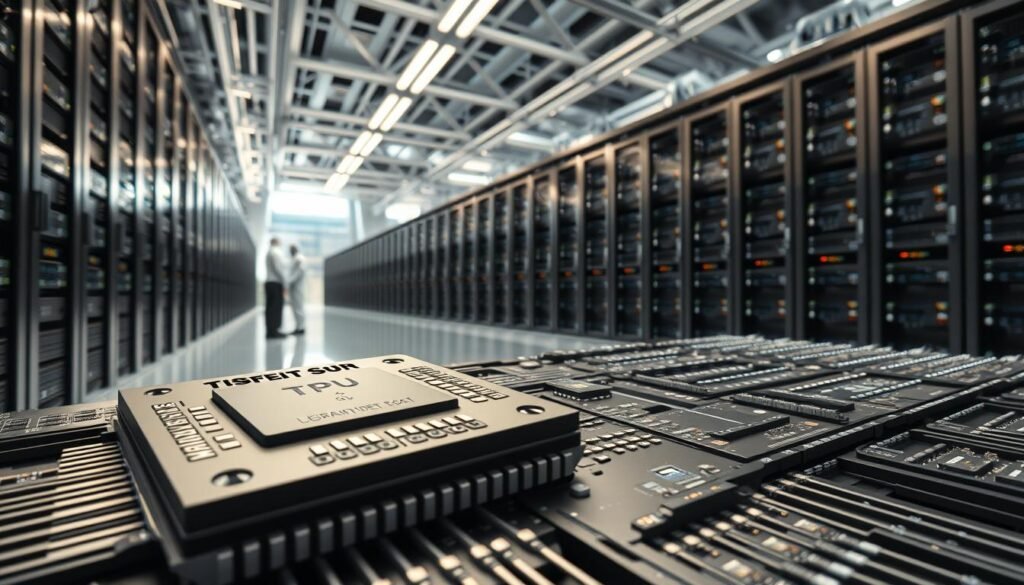
A sleek, state-of-the-art data center filled with rows of server racks housing the latest tensor processing units (TPUs). The TPUs are rendered in intricate detail, their intricate silicon wafers and cooling systems visible under soft, directional lighting. In the foreground, a close-up of a single TPU chip showcases its advanced architecture, with labeled components and annotated performance specifications. The midground features a panoramic view of the data center, with technicians in clean room suits maintaining the systems. The background depicts the larger facility, with architectural elements that evoke a sense of modern, cutting-edge technology. The overall scene conveys the power and sophistication of TPU hardware, hinting at its pivotal role in powering the next generation of AI and machine learning.

Understanding Tensor Processing and Inference Computing

I find tensor processing units represent a specialized approach to AI workloads. Unlike flexible graphics processors, these chips focus specifically on matrix mathematics. This specialization delivers remarkable efficiency for running trained models.

Google’s seventh-generation Ironwood TPU demonstrates this advantage. It handles heavy AI workloads with performance gains exceeding four times its predecessor. The hardware excels at inference computing where most operational expenses occur.

Cost Efficiency, Performance Trade-offs, and the “Nvidia Tax”

The economic implications are staggering when I analyze the numbers. Nvidia commands estimated 80% gross margins on data center chips. While manufacturing might cost $3,000-$5,000, hyperscalers pay $20,000-$35,000 per unit.

This “Nvidia tax” creates massive cost pressure. Google’s custom silicon strategy may deliver compute power at roughly 20% of comparable Nvidia GPU costs. The 4x-6x efficiency advantage directly impacts product pricing and company viability.


FAQ

What is the main difference between OpenAI’s Stargate project and Google’s TPU Pods?

The core difference lies in strategy. OpenAI’s Stargate represents a massive, custom-built data center project, heavily reliant on a partnership with Microsoft. Google’s TPU Pods are its own internally developed and deployed hardware, designed for maximum efficiency in running its Gemini models and other workloads. Stargate is an ambitious investment, while TPU Pods are a proven, operational infrastructure.

Why are companies like Google developing their own AI chips instead of just using Nvidia GPUs?

The primary driver is cost and control. While Nvidia GPUs are powerful, they come with a significant premium, often called the “Nvidia tax.” By creating custom silicon like the Tensor Processing Unit (TPU), Google can optimize hardware specifically for its software stack. This leads to better performance per watt and lower long-term expenses for training and running massive AI models.

How do Google’s TPUs achieve better cost efficiency compared to traditional GPUs?

TPUs are application-specific integrated circuits (ASICs) built for tensor processing, the core math behind neural networks. This specialization means they don’t have the general-purpose circuitry of a GPU. They perform AI workloads faster while consuming less electrical power. This directly translates to lower operational costs in the data center for large-scale model training and inference.

Is OpenAI’s partnership with Microsoft for Stargate a sign that building custom AI hardware is too difficult?

I see it more as a strategic choice. Developing cutting-edge silicon requires immense capital and years of expertise. OpenAI’s strength is in model research. Partnering with Microsoft, which has its own Azure hardware stack, allows OpenAI to focus on AI development while leveraging a tech giant’s infrastructure capabilities. It’s a different path to the same goal: unprecedented compute capacity.

What does this competition mean for the broader AI market and other companies?

It signals a major shift. The high cost of compute is a barrier for many. If Google’s TPU strategy proves vastly more economical, it could pressure other cloud providers to develop competitive custom silicon. This competition may eventually drive down costs for all customers. However, it also risks consolidating power among a few tech giants who can afford these multi-billion-dollar investments.
Tags: Artificial Intelligence BattlesOpenAI vs GoogleStargateTPU Pods
TweetShare
Aymen Dev

Aymen Dev

Aymen Dev is a Software Engineer and Tech Market Analyst with a passion for covering the latest AI news. He bridges the gap between code and capital, combining hands-on software testing with financial analysis of the tech giants. On SmartHackly, he delivers breaking AI updates, practical coding tutorials, and deep market strategy insights.

Related Stories

A split-screen illustration showing a man running in a dark, server room on the left with a glitching red logo, contrasted with a blue Google-style logo and a rocket labeled "ANTIGRAVITY" launching over a bright cityscape on the right, with code overlaying both sides

Panic at OpenAI? “Operator” Leaks Hours After Google Antigravity Launch

by Aymen Dev
December 6, 2025
0

The "AI Cold War" just turned hot. Less than 24 hours after Google shook the industry with Antigravity, a massive OpenAI Operator leak has surfaced, suggesting a desperate...

Futuristic illustration of AWS Frontier Agents Kiro, Security, and DevOps autonomously building code structures in a cloud data center, symbolizing the end of manual coding

AWS Frontier Agents: The End of Manual Coding?

by Aymen Dev
December 4, 2025
0

While the world was distracted by OpenAI's pricing controversy, Amazon just quietly dropped a nuclear bomb on the software industry. At the latest AWS conference in Las Vegas,...

Futuristic illustration showing a chat interface dissolving into a network of autonomous AI agents, symbolizing the shift from chatbots to agentic AI in 2026.

The End of “Chat”: Why 2026 Will Be the Year of Autonomous Agents (Deep Dive)

by Aymen Dev
December 1, 2025
0

For the last three years, we have been stuck in the "Chatbot Era." You type a prompt, the AI types back. You copy-paste the code, test it, find...

Futuristic split-screen illustration of OpenAI Operator and Google Jarvis as autonomous AI agents fighting for control of a computer interface.

Leaked: OpenAI “Operator” vs. Google “Jarvis” – The Battle to Control Your PC Begins

by Aymen Dev
December 1, 2025
0

The era of "Chatting" with AI is officially over. The era of "Acting" has begun. And the centerpiece of this revolution is the leaked OpenAI Operator agent. According...

Next Post
Building a Private RAG Chatbot with Mistral and Python (No API Costs)

Private RAG Chatbot with Mistral and Python (No API Costs)

Leave a Reply Cancel reply

Your email address will not be published. Required fields are marked *

SmartHackly

SmartHackly delivers the latest AI news, automation trends, and productivity insights. Explore smart tools and guides to help you work efficiently in the digital age.

Recent Posts

  • ChatGPT 5.2: The Ultimate 2026 Survival Guide to Mastering Agent Workflows
  • AI Agents Vs Traditional Automation: What You Need To Know In 2026
  • How Perplexity AI Agents Are Transforming Enterprise Automation

Categories

  • AGI
  • AI Applications
  • Enterprise
  • News
  • Open Source
  • Resources
  • Robotics
  • Startups

Weekly Newsletter

  • About
  • Privacy Policy
  • Terms and Conditions
  • Contact Us

© 2025 SmartHackly - Your source for AI tools, automation insights, and tech innovation. All rights reserved.

Welcome Back!

Login to your account below

Forgotten Password?

Retrieve your password

Please enter your username or email address to reset your password.

Log In
No Result
View All Result
  • News
  • AGI
  • AI Applications
  • Enterprise
  • Robotics
  • Open Source
  • Resources
  • Startups

© 2025 SmartHackly - Your source for AI tools, automation insights, and tech innovation. All rights reserved.