
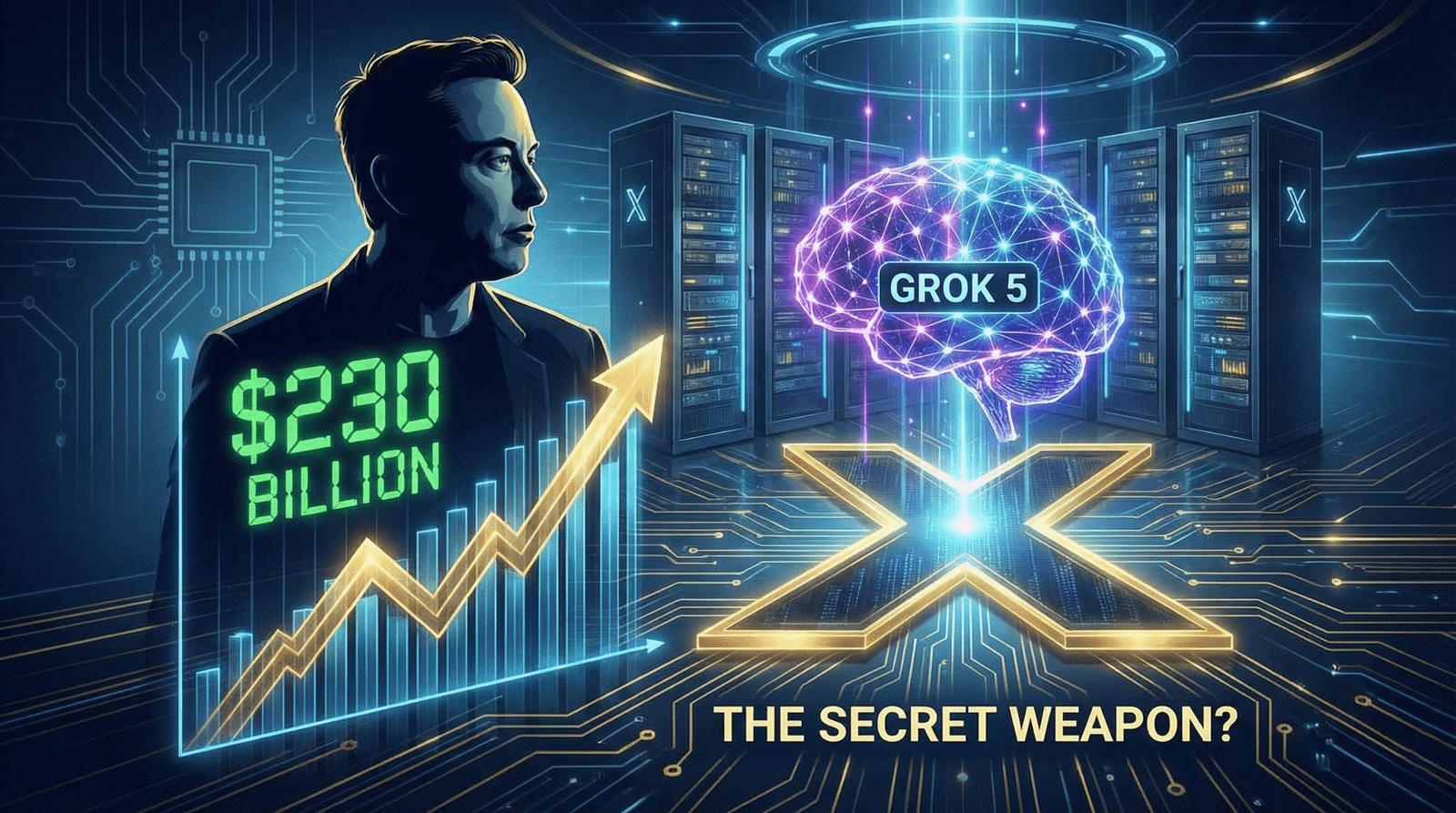
The xAI valuation wars have officially entered a new stratosphere. Late Thursday, reports confirmed that xAI, Elon Musk’s artificial intelligence company, is closing a fresh funding round of $15 billion.
But the number that has Silicon Valley spinning is the new market cap: $230 Billion.
To put that in perspective, this staggering xAI valuation effectively doubles the company’s worth in just six months. It is now sitting comfortably as the second most valuable AI lab in the world, nipping at the heels of OpenAI. This price tag makes xAI more valuable than industry titans like McDonald’s, Disney, or Nike.
What do top-tier investors like Valor Equity Partners, Andreessen Horowitz, and Sequoia Capital see that justifies this massive xAI valuation? The answer isn’t just a chatbot. It is a high-stakes bet on three pillars: Hardware (Colossus), Intelligence (Grok 5), and the Musk Ecosystem.
1. Behind the xAI Valuation: The “Colossus” Factor
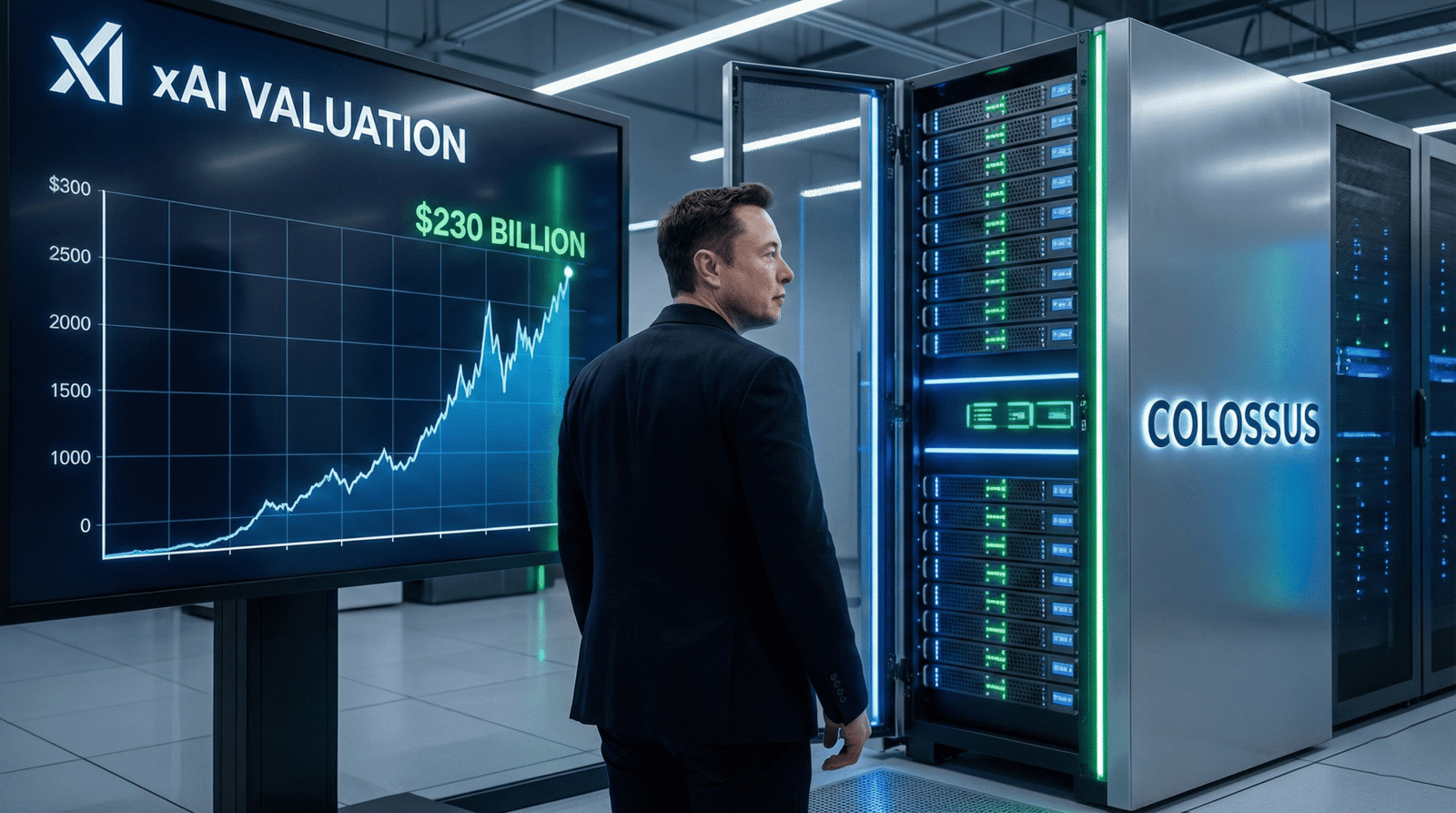
Investors aren’t just buying software; they are buying physical infrastructure. xAI’s supercomputer cluster in Memphis, Tennessee—dubbed Colossus—is currently the largest AI training cluster on Earth.
While competitors like Google and Microsoft struggle with power constraints and chip shortages, Musk used his legendary logistics expertise (borrowed from Tesla’s supply chain) to build Colossus in just 122 days. This is a process that typically takes 12 to 24 months.
This unprecedented speed is a primary driver of the soaring xAI valuation because it guarantees training supremacy.
The Hardware Specs
- GPU Count: Over 100,000 NVIDIA H100s active today, scaling to 200,000 with the addition of the new H200s.
- Networking: Uses NVIDIA’s Spectrum-X ethernet fabric, allowing for faster data transfer between chips than traditional setups.
- Power: A massive localized power grid deal in Memphis that allows xAI to burn energy at a rate competitors can’t match.
The “Energy War” Controversy
It hasn’t been smooth sailing. Local activists in Memphis have raised alarms about Colossus’s massive resource consumption. Specifically, the installation of gas turbines to bypass the local grid limits has sparked debate.
For investors, however, this is a feature, not a bug. It proves Musk is willing to “break things” to get the power needed for AGI, bypassing the bureaucratic gridlock slowing down Amazon and Google.
Watch: Elon Musk explains the scale of the Colossus Supercomputer.
2. The Grok 5 Rumors: “Project Valis” and AGI
The xAI valuation spike coincides with Musk’s recent teases about Grok 5 (internally codenamed “Project Valis”). It is reportedly deep in training on the Colossus cluster right now.
While Grok 2 and 3 were playing catch-up to GPT-4, sources suggest that early checkpoints of Grok 5 are showing “emergent reasoning” capabilities that surpass even the newly released GPT-5.1.
The “League of Legends” Test
Musk has claimed Grok 5 will attempt to beat a professional human team at League of Legends. Why does this matter for the xAI valuation?
MOBA games require long-term strategic planning, real-time reaction, and teamwork (multi-agent coordination). Current LLMs like ChatGPT are turn-based (you talk, they talk). Grok 5 is being built as a Real-Time Agent.
If Grok 5 can handle the chaos of a video game, it can handle the chaos of a real-world desktop environment. This capability alone could justify the massive price tag.
- Multimodal Native: Grok 5 is rumored to handle real-time video and audio with zero latency (essential for the Optimus robot).
- Reasoning: It reportedly uses a new “System 2” thinking process similar to OpenAI’s o1, but applied to live video streams.
3. The “Muskonomy”: The Secret Data Flywheel
The unique value proposition supporting the xAI valuation is its integration with Elon Musk’s other companies. No other AI lab has access to this kind of proprietary real-world data.
X (Twitter): The Pulse of Humanity
Grok has exclusive, real-time access to the global “town square.” When news breaks, Grok knows it instantly. ChatGPT and Gemini have to wait for web crawlers to index news sites. This makes Grok the undisputed king of “Real-Time News.”
Tesla: The “World Model” Advantage
This is the sleeping giant. Tesla has millions of cars on the road recording video. xAI is reportedly using this massive FSD (Full Self-Driving) dataset to train Grok’s “World Models.”
To build AGI, a computer needs to understand physics, object permanence, and human behavior. Text isn’t enough. Tesla provides the video data necessary to teach Grok how the physical world works, a massive advantage over Nvidia’s partners who rely on synthetic data.
Optimus: The Body for the Brain
Grok is not just a chatbot; it is the brain of the Optimus Humanoid Robot. If xAI solves the “brain” for a robot that can do laundry or assemble cars, the value of the software is effectively infinite. That future potential is what the $230B xAI valuation is betting on.
Head-to-Head: xAI vs. OpenAI vs. Google
Where does xAI stand in the “Big Three” race? We broke down the metrics to see if the valuation makes sense.
| Feature | xAI (Grok) | OpenAI (GPT) | Google (Gemini) |
|---|---|---|---|
| Top Model | Grok 4.1 / Grok 5 (Beta) | GPT-5.1 (Orion) | Gemini 3.0 Ultra |
| Primary Data | X (Twitter) + Tesla FSD | Web Crawl + Partnerships | Google Search + YouTube |
| Compute | Colossus (100k+ H100s) | Azure (Microsoft) | TPU v5 Pods |
| Valuation | $230 Billion | ~$300 Billion | $2 Trillion (Alphabet) |
This table reveals the core difference: xAI is the only player that owns its entire stack—from the energy grid in Memphis to the distribution platform on X. OpenAI relies on Microsoft; Anthropic relies on Amazon/Google. Musk relies on Musk.
The Bear Case: What Could Go Wrong?
Despite the hype, the $230 billion xAI valuation is a massive gamble. Critics point out two major risks that could pop this bubble:
- The Revenue Gap: OpenAI is generating nearly $13 billion in annualized revenue as of late 2025. xAI is estimated to be around $500 million. Investors are paying a 400x revenue multiple for xAI, betting entirely on future potential rather than current cash flow.
- The “Key Man” Risk: Elon Musk runs Tesla, SpaceX, Neuralink, X, and xAI simultaneously. If his attention is divided, execution could slip. We saw this with Tesla’s stock dip during the Twitter acquisition. Can he truly manage the world’s largest supercomputer while launching Starships to Mars?
Developer Verdict: The “Bubble” or the Breakout?
A $230 billion xAI valuation for a company with a fraction of OpenAI’s revenue looks like a bubble on paper. However, in the AI arms race, Compute is Currency.
Musk has the most compute (Colossus). He has the most unique data (X + Tesla). And he has the fastest deployment speed. If Grok 5 delivers on the “AGI” hype in Q1 2026, this price tag might actually look cheap in hindsight.
Frequently Asked Questions (FAQ)
What is xAI’s current valuation?
As of November 2025, the xAI valuation stands at approximately $230 billion following a massive $15 billion funding round.
When will Grok 5 be released?
Elon Musk has hinted at an early 2026 release for Grok 5, stating that it aims to be the “smartest AI globally” and may have a chance at achieving AGI.
What is the Colossus Supercomputer?
Colossus is xAI’s massive data center in Memphis, housing over 200,000 NVIDIA GPUs. It is currently regarded as the most powerful AI training cluster in the world.
Is Grok better than ChatGPT?
The new Grok 4.1 currently beats GPT-4o on several leaderboards, particularly in mathematics and coding, though GPT-5.1 still holds the edge in creative writing.